
The math practice Stanley brings home most days follows a pattern like this: read several sentences that feel long to a first grader, understand the situation, show his thinking, write an equation, and complete the calculation.
I love watching him read, find useful clues, and turn the events described in words into drawings, numbers, and symbols. The part that interests me most is this process: how does an equation grow out of a sentence?
This approach to learning mathematics speaks deeply to me.
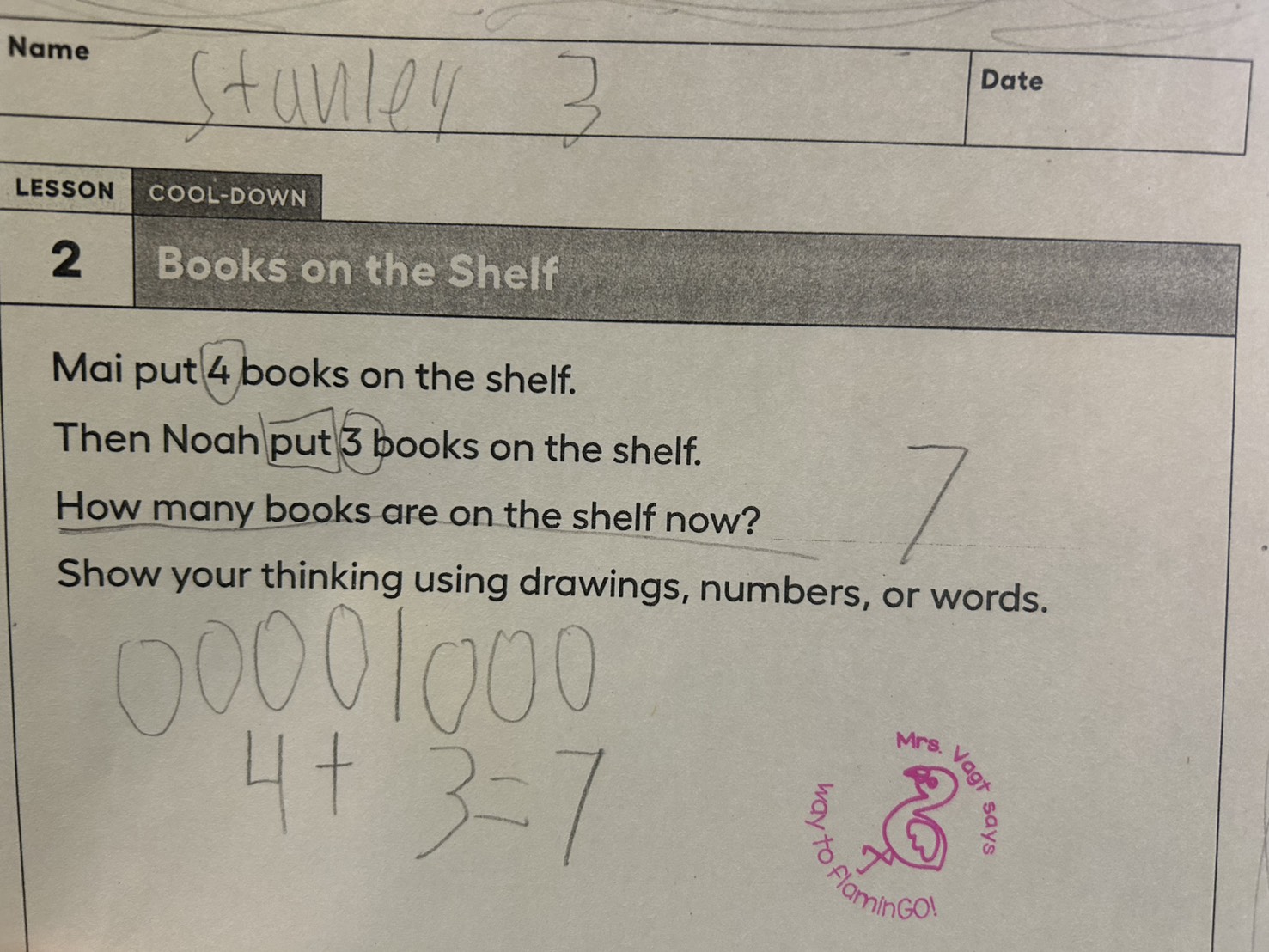
The worksheet invites children to show their thinking through drawings, numbers, or words. Stanley’s reading marks, two groups of circles, and equation leave a visible record beyond the final answer.
Seven books, and the thinking before the answer
The worksheet in the photo is called “Books on the Shelf.” Mai puts four books on a shelf. Then Noah puts three books on the shelf. How many books are there now?
Four plus three equals seven is easy for an adult. For a child who is learning, there is a meaningful path to travel before writing that equation.
What do four and three represent? Where did each person put the books? Do the three new books join the original four? Does the question ask about one person’s books or all the books on the shelf now?
In the photo, Stanley has circled four and three and marked the action and final question. He has drawn four circles and three circles, separated by a line, and written “4 + 3 = 7.”
One worksheet cannot tell me the actual sequence of his thoughts. But his marks give us somewhere to begin a conversation: What does each group represent? Why do we add them?
I especially like the final instruction, which offers drawings, numbers, or words as ways to show thinking. Children have several ways to express their understanding, and adults have a chance to see where an answer comes from.
Reading means connecting sentences into a situation
From a language-learning perspective, understanding a problem involves vocabulary, sentence structure, and connections across sentences.
Cognitive accounts describe a “situation model”: a mental representation of events and relationships. Solving a word problem also involves translating that representation into a mathematical model. Reading comprehension, working memory, and reasoning contribute to this process.[1]
Here, the child needs to connect two actions involving the same shelf. Words such as “then” and “now” help establish the sequence and the point in time the question concerns.
Asking a child to retell the problem creates an opportunity to organize understanding: What happened? What do we know? What are we trying to find?
“Struggling with math” can hide different difficulties
Reading comprehension may be one part of a child’s difficulty with word problems. It is worth looking at where the difficulty occurs.
A child might calculate successfully but misunderstand the question. Another might recognize every word without connecting the sentences. Another might understand the story but struggle to express the quantities as an equation.
Because several abilities contribute to word-problem solving, reading cannot explain every difficulty.[1] An incorrect answer alone does not identify the source.
This changes how I want to help. If the situation is unclear, we can retell it or draw it. If the quantities are unclear, we can act it out with objects. If the relationship makes sense but the calculation goes wrong, we can practice the calculation.
First, understand where the child needs support.
Finding clues also means understanding relationships
I like seeing Stanley mark useful information. Circling numbers and words is a starting point; the next question is how those pieces relate.
Here is an example I made up: “Alex has eight candies, three more than Mia. How many candies does Mia have?” Although the sentence contains “more,” finding Mia’s amount requires subtracting three from eight.
The child must identify who has more, the difference, and whose amount is unknown. Research cautions that choosing operations from surface clues can bypass understanding the situation.[1]
I hope Stanley learns to connect the clues and explain the equation he chooses.
Words, drawings, and equations can support one another
This worksheet shows me a useful bridge between language and mathematics.
Words describe events. Circles represent quantities. An equation expresses their combination. A child can check the connections: Does the drawing match the story? Does the equation match the drawing?
The U.S. Institute of Education Sciences recommends explicit mathematical language, concrete and semi-concrete representations, and deliberate word-problem instruction to support elementary mathematics learning.[2]
These recommendations help me articulate what I value: understandable situations and opportunities to develop mathematical relationships through objects, drawings, explanations, and symbols.
More text does not automatically mean better teaching. Sentences beyond a child’s comprehension can obscure the mathematics. For a child learning English, retelling, images, and objects can support access to the problem while preserving opportunities to reason.
A visible record, and a chance to look back
Drawing and writing equations leave a record we can discuss.
The answer seven tells us little on its own. With a drawing and an equation, we have more evidence for distinguishing a misunderstanding from a calculation error.
This makes me think about metacognition: attending to and checking one’s understanding and strategies. At home, I can ask, “Does this answer make sense in the story?” or “Can you explain it another way?”
These are possibilities I see for supporting learning. Completing a worksheet does not establish that a child has developed mature metacognition. Small conversations can give us opportunities to practice looking back.
Calculation fluency matters too; the same teaching guide includes activities to build fluency.[2] I want understanding and fluency to grow together, so he can calculate and explain why the calculation fits.
The moment I have loved since childhood
Watching Stanley work reminds me of my own childhood.
Word problems were my favorite. Reading a story, finding clues, understanding the quantities, and writing an equation felt like solving a puzzle.
Rows of repetitive calculations designed to build speed rarely held the same appeal. I liked having a question to explore and meaning to understand before finding a solution.
What I loved was the moment when things made sense.
Now, watching Stanley read a series of sentences and gradually turn a situation into an equation, I recognize a kind of learning I have always enjoyed: a story, some thinking, and the pleasure of understanding what to do and why.
Further reading and learning record
- Worksheet: “Books on the Shelf,” Lesson 2, Cool-Down.
- Situation: four books placed on a shelf, followed by three more; find the current total.
- Visible work: reading marks, two groups of circles, and “4 + 3 = 7.”
- [1] Hickendorff (2021): The Demands of Simple and Complex Arithmetic Word Problems on Language and Cognitive Resources.
- [2] Institute of Education Sciences (2021): Assisting Students Struggling with Mathematics: Intervention in the Elementary Grades.
This article connects a family observation with educational research and personal reflection. The photo records visible work; it cannot establish the child’s complete thought process or represent every school or learner.