
Selected applied work

I work where AI must be explained, tested, taught, and carried into practice.

These examples were selected from published research, teaching practice, and documented collaborations because they connect directly to current needs: agent-enabled workflows, human oversight, healthcare trust, cross-functional delivery, and practical AI literacy.

3 monthsCross-border healthcare AI POC
2+ yearsReal startup HR system in operation
5 daysSeattle youth program delivery format
Data to decisionAiraHost Airbnb pricing model
University of Washington · Agentic AI · 2026Coding lab & classroom demonstration

A coding starting point for building AI trading systems

The session began with a focused 15-minute introduction, then moved into the main learning experience: a coding lab built around a complete AI-trading example. Students received a practical starting point for exploring how market data can become model signals, agent actions, risk checks, and explainable recommendations.
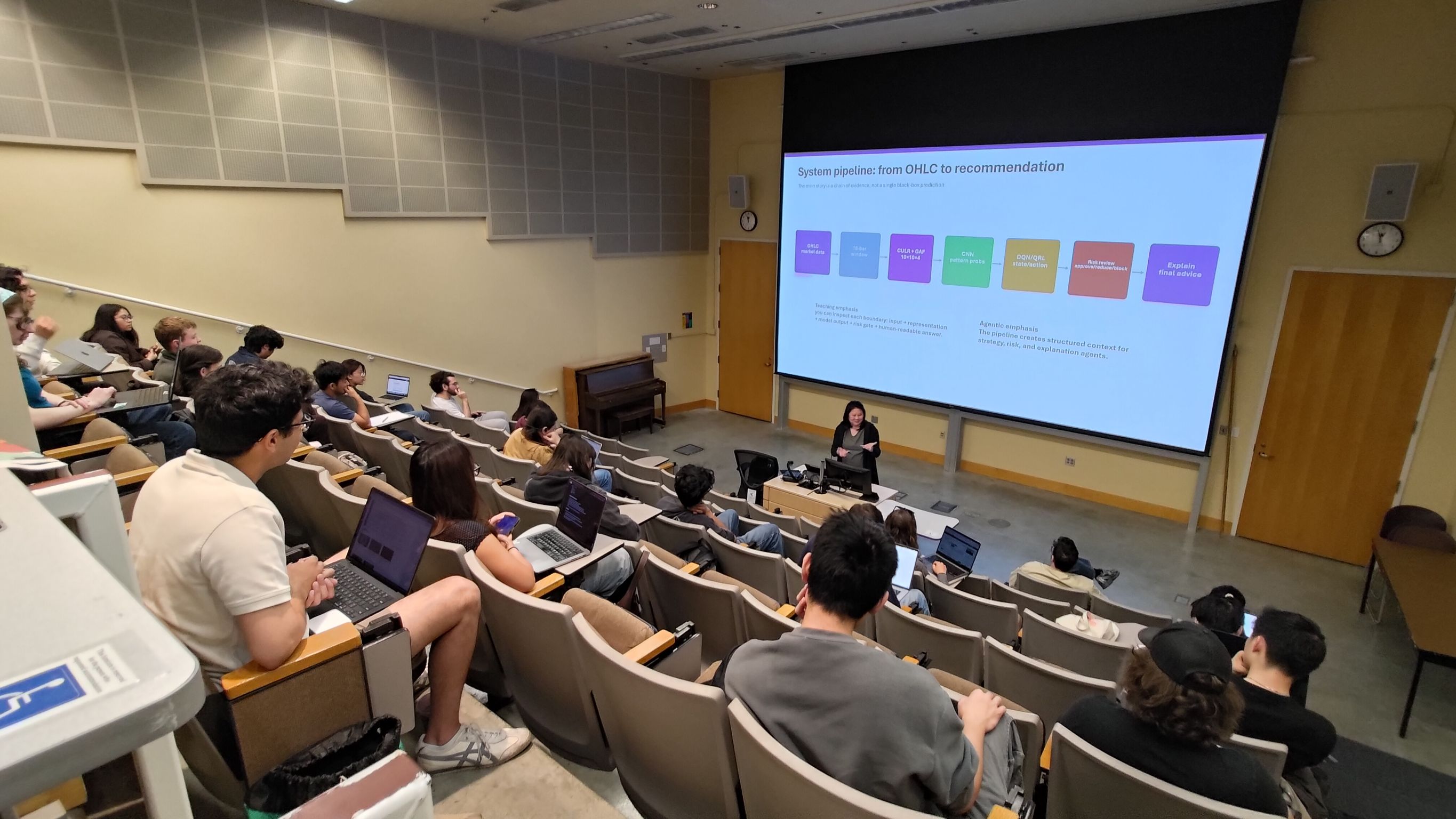
Yun-Cheng (Pecu) Tsai speaking to a full University of Washington classroom while presenting an Agentic AI system pipeline
University of Washington · SeattleLive classroom talk and demonstration

What students could build from

  • OHLC market data and 10-bar windows transformed through CULP + GAF representation.
  • A CNN pattern probe feeding DQN/DRL state and action decisions.
  • A human-readable risk review that can approve, reduce, or block a proposed action.
  • A final explanation that joins the strategy, Q-values, risk decision, and suggested position size.

Open demo and results

I provided the complete lab notebook, not only presentation slides, so students could inspect the code, reproduce the workflow, and continue experimenting after class. The two interactive result views make the model signals and agent decisions visible.

What this demonstrates: a hands-on learning path from a short conceptual framing into working code. Students left with a reusable AI-trading lab example and a concrete foundation for further study, while evidence, risk, and the human control point remained visible.

The University of Washington name identifies the documented speaking venue and does not imply institutional endorsement. The financial demo is an educational decision-support example, not investment advice or a claim of production performance.
Applied AI · digital twin · smart buildingOne-year advisory engagement

AIoT cross-system environmental management

A year-long university-industry consulting engagement that turned an AI-designed digital twin into a working smart-building demonstration.

The operating challenge

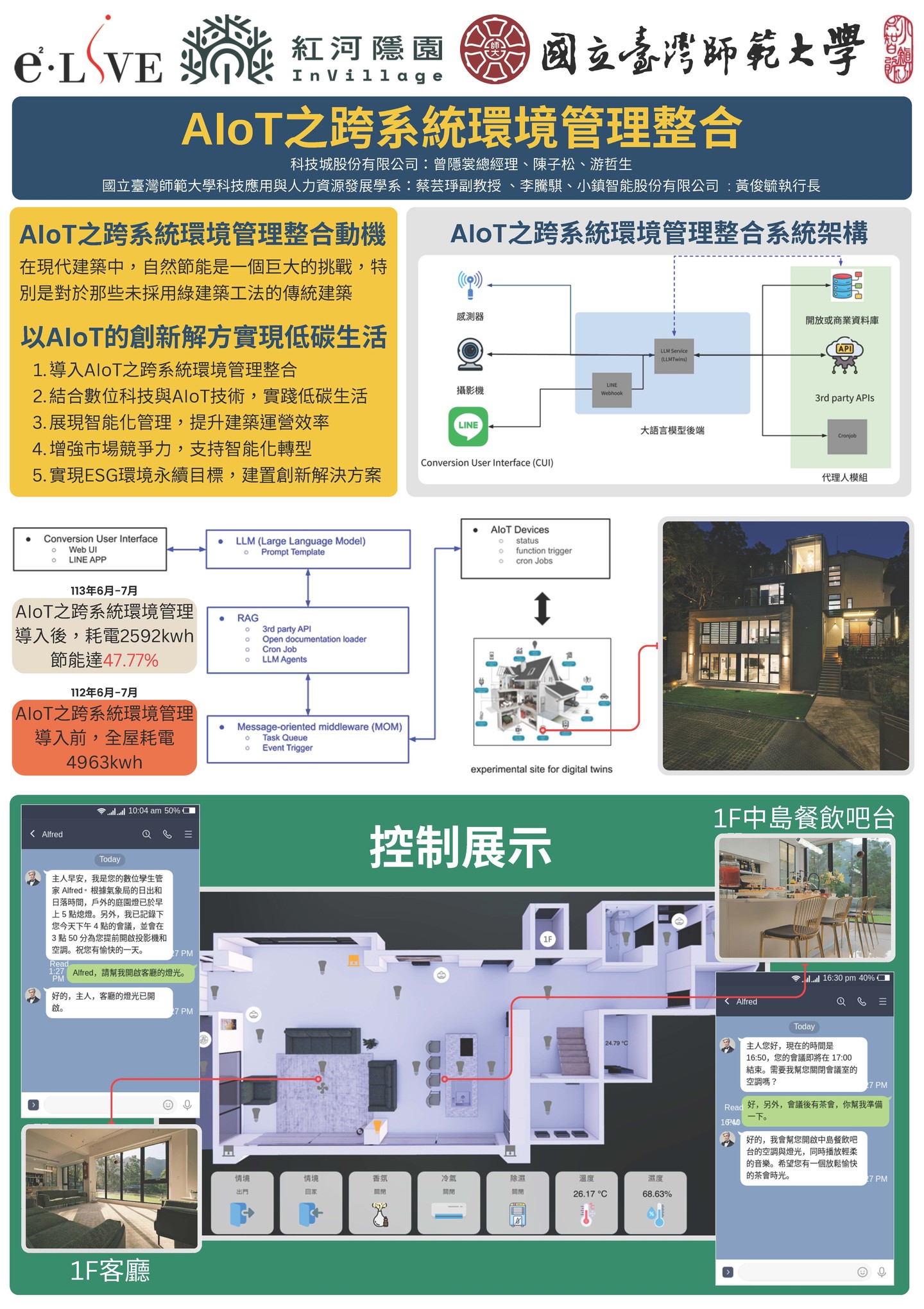
The project connected sensors, camera feeds, LINE, large-language-model services, third-party APIs, and automated tasks so people could monitor and control a real residential environment through conversation.

Documented outcomes

  • 47.77% measured electricity savings in the documented comparison period.
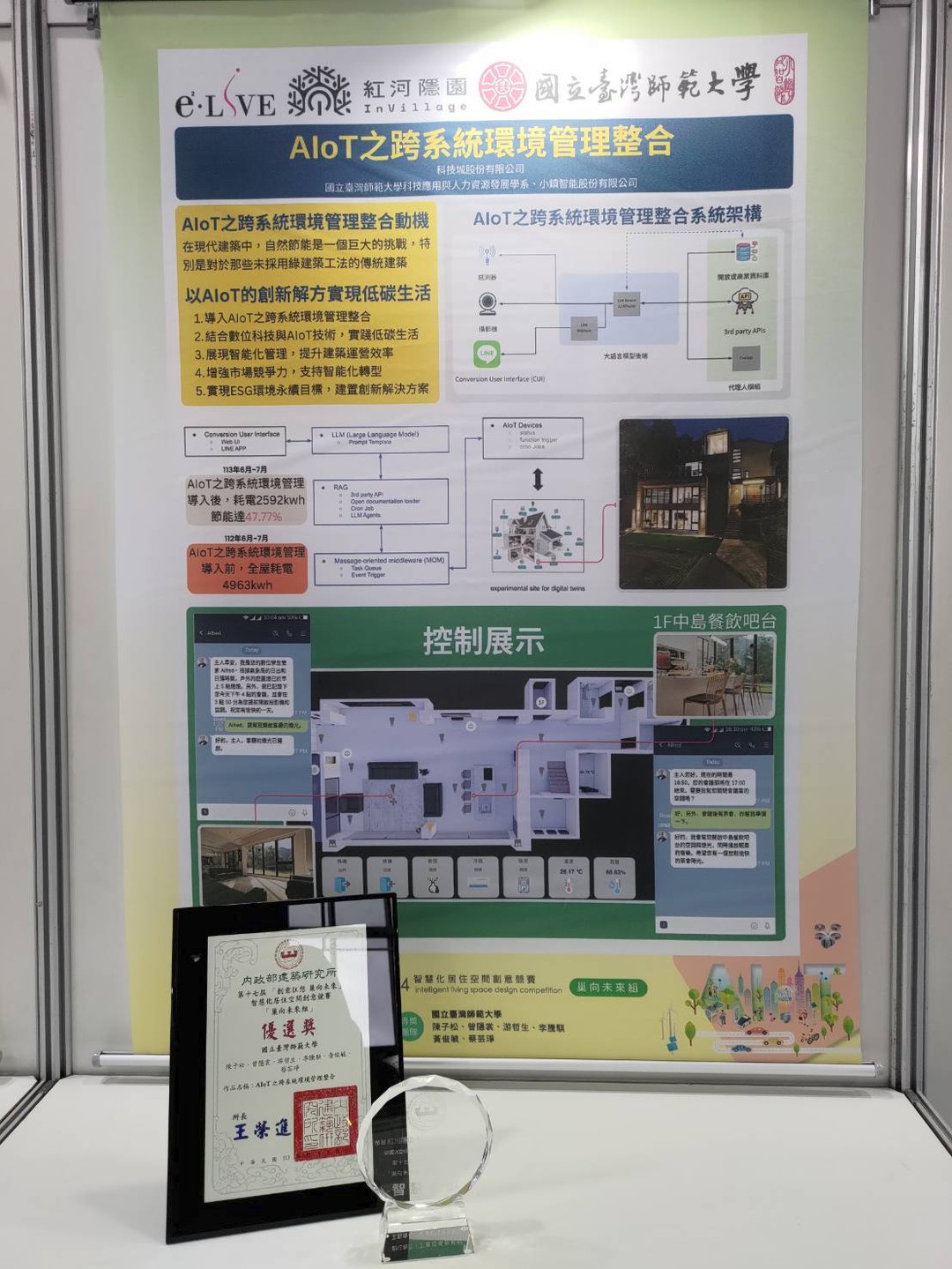
  • 2024 Merit Award in the Intelligent Living Space Design Competition.
  • The field implementation was subsequently developed into an IEEE publication.
AIoT cross-system environmental management project poster showing the digital-twin architecture, electricity-saving result, and conversational control interface
System evidenceDigital-twin architecture, field site, energy result, and control interface
AIoT project poster displayed with the 2024 Intelligent Living Space Design Competition certificate and trophy
Public recognition2024 competition certificate and award

What this demonstrates: a complete consulting path from problem framing and system-integration coordination through field testing, measurable evidence, and research translation. This was a client-specific demonstration, not a packaged off-the-shelf product.

Read the IEEE paper → · See the 2024 award story →

Competition, university, and company names describe the documented project context and do not imply endorsement of PECULAB services.

Healthcare AI · cross-border civic project · 2024POC leadership

Jubo N-Copilot: a three-month healthcare AI collaboration

A real project connecting an eldercare technology company, students from NTNU PecuLab, and Minerva University’s Civic Project.

The operating challenge

The team explored an AI assistant for nurses while balancing patient privacy, traceable decisions, limited computing resources, security expectations, and usability in a busy clinical setting.

My practical role

  • Helped define the project challenge and meaningful outcomes.
  • Structured the work into smaller technical and documentation tasks.
  • Coordinated biweekly communication across institutions and cultures.
  • Connected student development work with the company’s security and operating expectations.
  • Supported the path from working functions to demonstration at the Taiwan Healthcare+ Expo and final project presentation.

What this demonstrates: cross-border POC leadership, stakeholder translation, documentation discipline, human-centered healthcare AI, and the ability to keep a short project moving toward visible evidence.

Read the documented project story →
Startup HR · performance systems · 2023-2026Operational implementation

A simplified 360-degree performance system used for more than two years

A practical HR system for a fast-growing company, designed to be light enough to use and structured enough to improve feedback.

The operating challenge

A startup needed clearer goals, multi-source feedback, and follow-up actions without introducing a heavy enterprise process that teams would avoid.

My practical role

  • Helped translate the HR need into a simplified operating design.
  • Structured daily feedback records so patterns and follow-up could be reviewed.
  • Connected computer-science and data thinking with workforce-development practice.
  • Learned from more than two years of real organizational use rather than a one-time demonstration.
  • Helped turn implementation lessons into research presented at ASSA 2026.

What this demonstrates: workflow design, adoption, longitudinal learning, research translation, and the discipline to improve a system after launch.

Public evidence: ASSA 2026 paper and presentation materials →
Short-term rental technology · AiraHostPricing recommendation model

Turning Airbnb market evidence into an explainable 30-day pricing plan

For AiraHost, I was responsible for completing the Airbnb price-recommendation model behind practical host-facing pricing guidance.

What the model supports

  • A suggested nightly rate and a day-by-day 30-day pricing plan.
  • A user-pinned Airbnb listing as the primary pricing benchmark.
  • Comparable-listing selection using location, property type, capacity, bedrooms, beds, baths, amenities, and travel dates.
  • Benchmark and local-market comparison, including structural similarity, price distribution, and market offset.
  • Confidence and data-quality explanations showing how many listings were collected, filtered, and used.
  • Supporting indicators such as weekday and weekend averages, estimated occupancy, and estimated monthly revenue.

My practical contribution

I connected the pricing problem, comparable-property evidence, model logic, confidence signals, and report outputs so a host could see both a recommendation and the basis behind it. The result is decision support with visible assumptions, not an unexplained number or an automatic promise of performance.

What this demonstrates: applied regression and recommendation modeling, comparable-market analysis, explainable model output, and end-to-end data-to-product delivery.

View the AiraHost sample report →

AiraHost labels its public sample report as generated with illustrative data. Sample prices, occupancy, confidence, and revenue values are demonstrations, not claimed client results. This case identifies my specific model contribution and does not imply authorship of the entire platform or endorsement of PECULAB services.

Clinical decision support · explainable AI · 2024-2025Trustworthy AI

Making clinical AI inspectable, not merely impressive

My healthcare work includes explainable clinical decision support for nursing assistants, AI applications in nursing, intelligent monitoring for eldercare, and robust wound-image segmentation under noisy real-world conditions.

The practical thread

  • Design AI output that a human professional can examine and challenge.
  • Keep privacy, provenance, uncertainty, and responsibility visible.
  • Evaluate performance under real data limitations, not only clean demonstrations.
  • Translate technical findings into language educators, nurses, and project stakeholders can use.

What this demonstrates: fit for healthcare learning, AI governance workshops, pre-production evaluation, and POCs where human review and documented limitations matter.

Public evidence: IEEE BigData clinical decision-support paper → · real-world wound segmentation preprint →

Higher education · generative AI · active learningLearning design

Teaching people to direct AI without outsourcing their thinking

My published education work has examined learner-centered educational big-data analytics, ChatGPT and Python API learning, retrieval-augmented Python education, digital humanities with generative AI, and project-based exploration of blockchain and emerging technology.

The practical thread

  • Start with learner questions and evidence, not tool demonstrations.
  • Require students to explain assumptions, test outputs, and document process.
  • Turn AI use into a project with visible decisions and feedback.
  • Build reusable course structures that other educators can facilitate.

What this demonstrates: four-session course design, faculty development, youth project studios, assessment redesign, and AI literacy that retains human judgment.

Public evidence: peer-reviewed active-learning and educational big-data study →
Finance · forecasting · reproducible pipelinesResearch to prototype

Turning models into experiments that can be reproduced and questioned

Across financial vision, reinforcement learning, forecasting, text-to-image analysis, quantum-assisted sequential models, and automated molecular-descriptor extraction, my work repeatedly connects a research question to data preparation, implementation, evaluation, comparison, and interpretable reporting.

The practical thread

  • Build reproducible data and modeling pipelines rather than one-off results.
  • Compare models against meaningful baselines.
  • Make evaluation criteria and limitations explicit.
  • Separate exploratory evidence from production readiness.

What this demonstrates: technical POC scoping, experimental design, model evaluation, research automation, and evidence-based go/no-go decisions.

Public evidence: Financial Innovation journal article → · open preprint and methodology →

Youth · high school · school-break learningCamp & studio design

Designing intensive AI learning for young people

My youth-program experience includes project-based camps and learning activities for middle-school and high-school learners. The work combines technical content with age-appropriate pacing, team roles, visible deliverables, mentoring, and the operational details required to run a real program.

2026 program delivery

I supported the Junior NATEA × UW Robotics, CS & AI Summer Program, held July 27-31, 2026 at the University of Washington Seattle campus for incoming grades 5-9. The five-day program includes block-based and Python coding, robotics design thinking, engineering skills, AI and machine-learning foundations, and problem solving.

Documented delivery: the Day 5 showcase photo records participants and mentors at the close of the completed five-day program. Venue and partner names describe the program context and do not imply endorsement of PECULAB services.

Public evidence: official program, curriculum, dates, and professor listing →
International social innovation · challenge designHackathon architecture

Designing challenges that move from ideas to prototypes

I have contributed hackathon and challenge design for Future Intelligence Hub initiatives, including formats that help learners and emerging innovators define a problem, form a team, build a practical response, and communicate it clearly.

The design approach

  • Use a meaningful future or community challenge instead of an open-ended technology contest.
  • Make participation possible for non-coders while preserving real building and testing.
  • Provide milestones for problem framing, prototype development, evidence, and pitch preparation.
  • Connect learning to responsible AI, sustainability, and possible implementation pathways.

What this demonstrates: hackathon curriculum, challenge rules, participant journey, judging logic, mentor structure, and cross-border program design.

View the FIH public program context →

What a collaboration delivers

More than credentials: a documented path to a usable result.

01

A problem worth solving

Users, constraints, responsibilities, risks, and success criteria defined before building.

02

A manageable delivery plan

Milestones, roles, review cadence, decision logs, and changes kept visible.

03

Work people can inspect

A course artifact, prototype, workflow, evaluation, or documented experiment, not only advice.

04

An honest next decision

Evidence for what to continue, revise, stop, teach, pilot, or hand to a production team.

Choose the appropriate product: a defined course or camp for learning outcomes; a staged POC for organizational evidence.

Why these examples now

The market has moved from “Can AI generate something?” to “Can people govern and repeat the work?”

Current adoption research shows broad organizational use of AI but agents are at a much earlier stage of deployment. The differentiator is increasingly the operating system around the model: documented workflows, human handoffs, quality standards, evaluation, and responsibility.

That shift matches PECULAB’s strongest applied experience, education that preserves judgment, POCs with explicit evidence, and AI systems designed for human review.