
Observe nature
Insect specimens revealed how small bodies achieve flight, balance, sensing, and efficient movement.
AI Future Lab Summer 2026 · August 3-7
During the August 5 University of Washington lab visit, high-school students saw more than tiny aircraft and robots. They saw how researchers observe nature, combine disciplines, test imperfect ideas, and turn small discoveries into useful technologies.
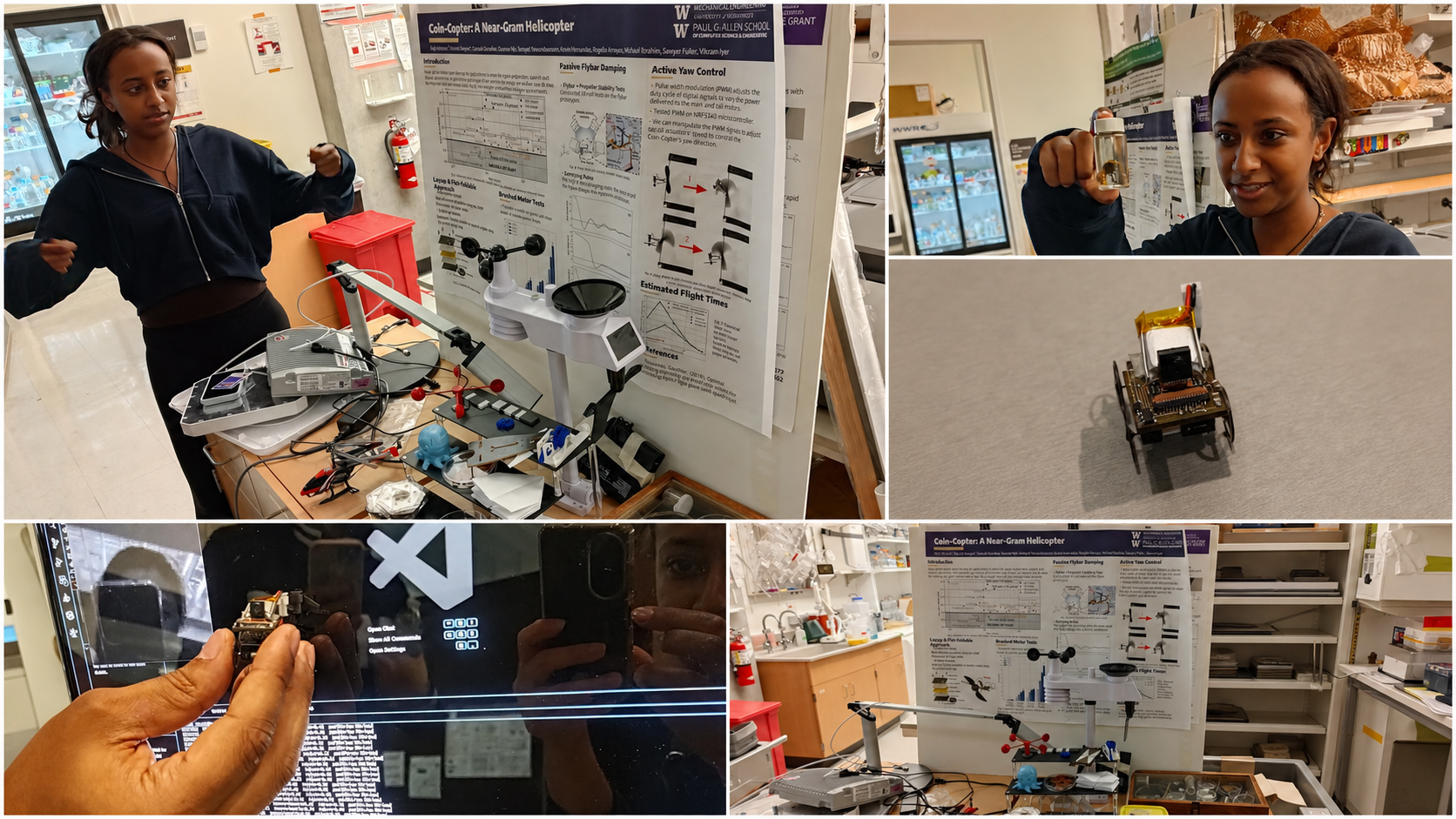
Editorial composite made from photographs supplied from the visit; no people or research objects were added. UW identifies the documented venue and does not imply institutional endorsement.
What students encountered
Insect specimens revealed how small bodies achieve flight, balance, sensing, and efficient movement.
The near-gram Coin-Copter combines extremely small motors, battery, circuitry, structure, and control.
Researchers compare propeller size, material, thrust, power use, folding behavior, stability, and yaw control.
A fingertip-sized wheeled robot integrates camera, battery, board, motors, wheels, live images, and code.
Nature solved flight, turning, balance, and sensing long before people built machines. The research process asks how an insect accomplishes complex work with very little mass, then translates those principles through mechanics, electronics, materials, programming, and repeated experiments.
The Coin-Copter illustrates the challenge. At approximately one gram, every component must be small and light while still producing enough thrust and stability. Foldable propellers reduce its footprint, then deploy for flight. Mechanical damping reduces oscillation, while software adjusts the main and tail motors to control direction.
Co-supervisor perspective: science is more than formulas, and code is more than text on a screen. Together, different kinds of knowledge can make an idea fly or help a fingertip-sized machine begin to see and move.
My role throughout all five days
As PecuLab founder and co-supervisor, I was present each day. Professor Shih-Chieh Hsu led curriculum design, research content, and academic-resource connections. I focused on whether students genuinely participated, crossed cultural boundaries, found a place in their teams, and began moving from learner toward contributor.
I observed how students entered teams, expressed ideas, and whether quieter students remained at the edge.
I helped parallel groups begin to intersect without completing the relationship-building work for students.
Local high-school assistants learned to notice not only technical problems, but also who had not yet understood or joined in.
The pathway continues from learner to assistant, assistant to instructor, and recipient of support to someone who opens the next door.
Students brought different ways of learning, speaking, asking questions, and joining groups. Some preferred to think fully before speaking; others shared ideas while they were still forming. My role was to help students recognize these differences as team resources, while ensuring that language, confidence, and educational habits did not quietly determine who participated.
Doctoral students taught high-school students; local high-school assistants supported peers; and the previous week, Junior NATEA high-school leaders had guided middle-school students. Together, these experiences formed a connected development pathway rather than isolated camps.
What we were developing: young people who learn technology while also learning to understand themselves, work with others, assume responsibility, and use their abilities to help someone else move forward.
The full week
The August 3-7 schedule combined Python and Matplotlib labs, deep learning, computer vision, reinforcement learning, generative AI, AR/VR, UW and ECE lab tours, a Microsoft GIX visit, capstone work, rehearsal, career sharing, and a student showcase.